ICON: A Conversation with Herb Greif
Event Details
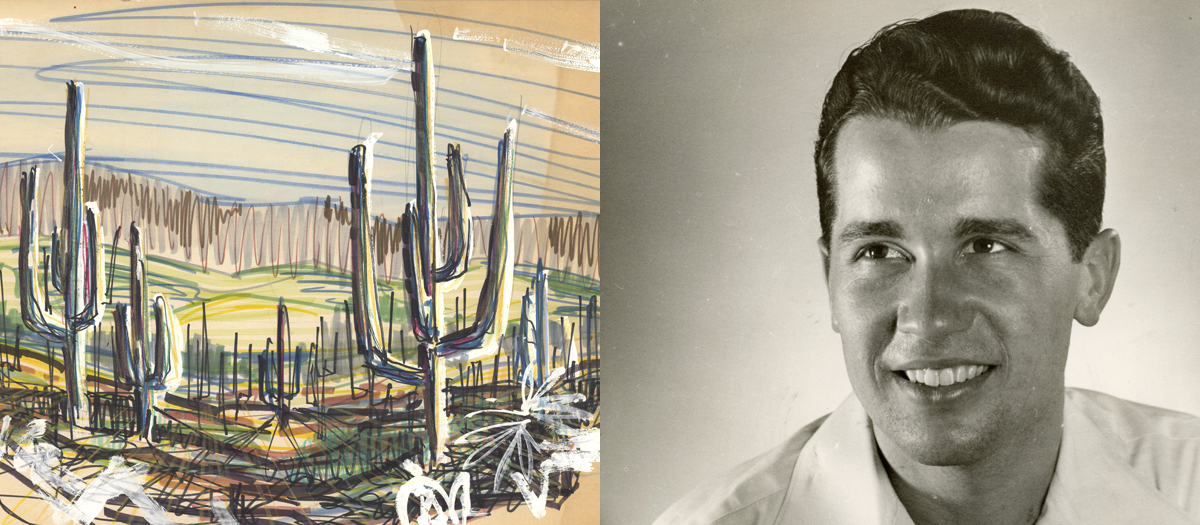
Join Tucson Modernism Week and Copenhagen Imports for a special evening celebrating the work of Herb Greif, a pioneering advertising man, illustrator, and designer whose work helped shape the visual and architectural identity of postwar Tucson. In this special program, Greif joins William Lawrence “Larry” Bird, Jr. and Carlos Lozano for a conversation about his life, work, and legacy. Together they will explore how art, design, and advertising intersected in mid-century Tucson, and how Greif’s creative vision continues to resonate in the city’s modern landscape.
From his early years as a technical illustrator at Infilco, designing intricate renderings of water systems, to his award-winning advertising campaigns for Kalt & Lauver, and later his independent design studio, Greif’s career reflects the evolution of modern visual culture in the American Southwest. His designs for homes, brochures, and civic projects captured the optimism of the mid-century desert city, from Sunset Dairy’s iconic “New Sunshine-Brite” campaign to Tucson’s “Parada de Casas” and architectural renderings for developments across the region.
Beyond commercial work, Greif’s artistic practice has spanned painting, sculpture, and environmental design. His decades-long contributions include museum exhibition design for the Pima Air & Space Museum, murals inspired by wartime posters, and architectural renderings for John Wesley Miller’s pioneering solar housing at Armory Park del Sol. Throughout his life, Greif has embodied the spirit of the Southwest — industrious, inventive, and deeply rooted in place.
Hosted at Copenhagen Imports, the evening includes a reception and exhibition of Greif’s original works, presented among the store’s modern furnishings — a fitting setting to reflect on the artistry, humor, and technical mastery that have defined his career.
Event is free, reservations are required.
Herb Greif
Born in Cleveland, Ohio, in 1928, Herb Greif began drawing at a young age and studied art at Ohio University before serving in the U.S. Coast Guard. After moving to Tucson in the 1950s, he became one of the city’s leading commercial artists and designers, blending fine art with industrial precision. His work has encompassed advertising, architectural renderings, murals, and residential design — all marked by wit, clarity, and craftsmanship. His creative output has shaped Tucson’s modern identity for over six decades.
William Lawrence “Larry” Bird, Jr.
Curator Emeritus, National Museum of American History – Smithsonian Institution. Bird received his B.A. in History from the University of Maryland, M.A. in History from the University of Arizona, and Ph.D. in History from Georgetown University. A former Rockefeller Foundation Humanities Fellow and recipient of a Four Freedoms Foundation research grant, Bird’s books and exhibitions for the Smithsonian include Design for Victory: World War II Posters on the American Home Front, Paint by Number, and American Democracy: A Great Leap of Faith and In the Arms of Saguaros: Iconography of the Giant Cactus. He lives in Tucson, Arizona.
Carlos Lozano
Carlos Lozano served an eight-year term on the Tucson-Pima County Historical Commission and continues as a Citizen Advisor on transportation issues. As chair of the Historic Landmark Sign Committee, he led successful efforts to amend Tucson’s Sign Code to preserve and encourage restoration of vintage neon. He studied Neon and Illuminated Sculpture at The Crucible in Oakland under Christian Schiess, and volunteers in the Library and Archives of the Arizona Historical Society, specializing in historic property research. His website, VanishingTucson.com, is being developed as a digital platform for his extensive oral history archive.